
Resources > Platform Guides & Support
Impact Data & Report Guide
By Vested Impact | Published Mar 12, 2026
Table of Contents
- Vested Impact Score
- Vested Impact Rating
- Country Impacts
- Impact History
- UN SDGs & Targets
- Activity Impacts
- Country & SDG Target Impacts
- Activity & Country Weightings
- Systemic Risk & Opportunity Flags
- ESG Impact & Financial Materiality
- ESG Risks & Opportunities
- Goal-based Benchmarks
- Indicators & Academic References
- Business Metrics
Impact Summary
Vested Impact Score
The Vested Impact Score is the combined negative risks and positive impacts across the business. It is calculated based on the aggregation of each activity/country/material issue combination (known as an ‘impact slice’). The score is the sum of adjusted average positive and adjusted negative impact scores across all slices, and is normalised to produce a score between -100 to 100.
The Vested Impact Score helps assess whether the positives outweigh the negatives and provides a clear picture of all material impacts. The Vested Impact Score is then converted into the Vested Impact Rating (AAA to D scale).
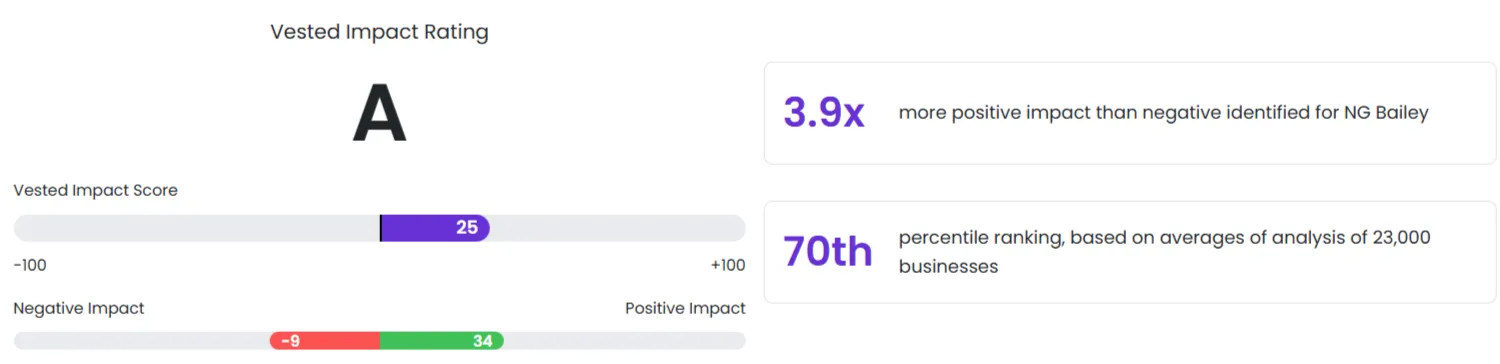
Vested Impact Rating
The overall negative risk and overall positive impact scores measure the depth of exposure within each dimension, not the balance between them. Scores are independently normalised (0 to 100) relative to maximum possible exposure in each dimension.
Country Impacts
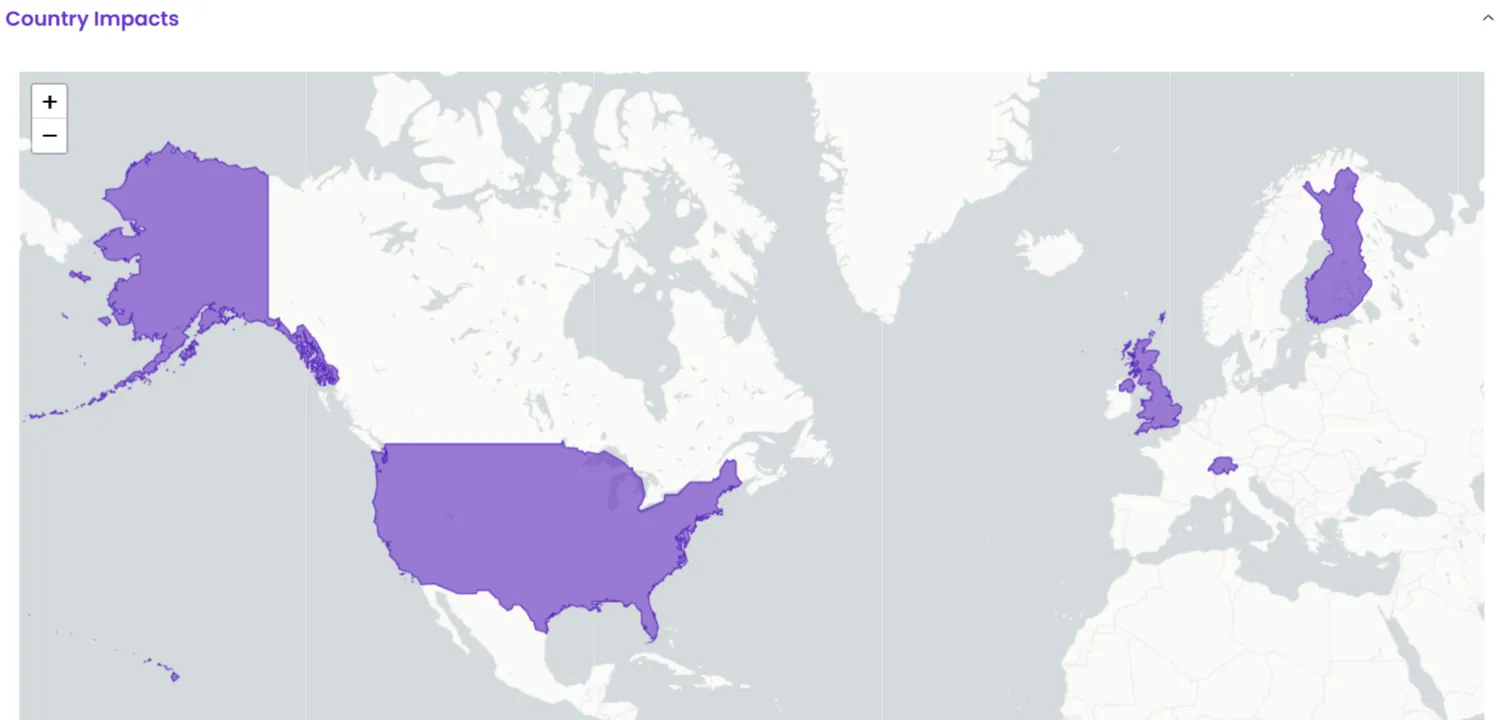
The same activity can present materially different risk and impact profiles depending on where they occur. Therefore, Vested Impact incorporates country-specific context when calculating the scale and scope of risk exposure and impact, ensuring a more accurate assessment across markets.
Environmental and social outcomes are shaped by local conditions, including but not limited to regulatory standards, resource scarcity, and ecosystem vulnerability. Accounting for these nuances helps ensure that impacts are not evaluated in a vacuum, but rather reflect the real-world context in which business activities occur. As a result, the assessment provides a more meaningful view of where a company’s activities may create greater risks and opportunities, allowing users to better understand and compare impact performance across different regions.
Impact History
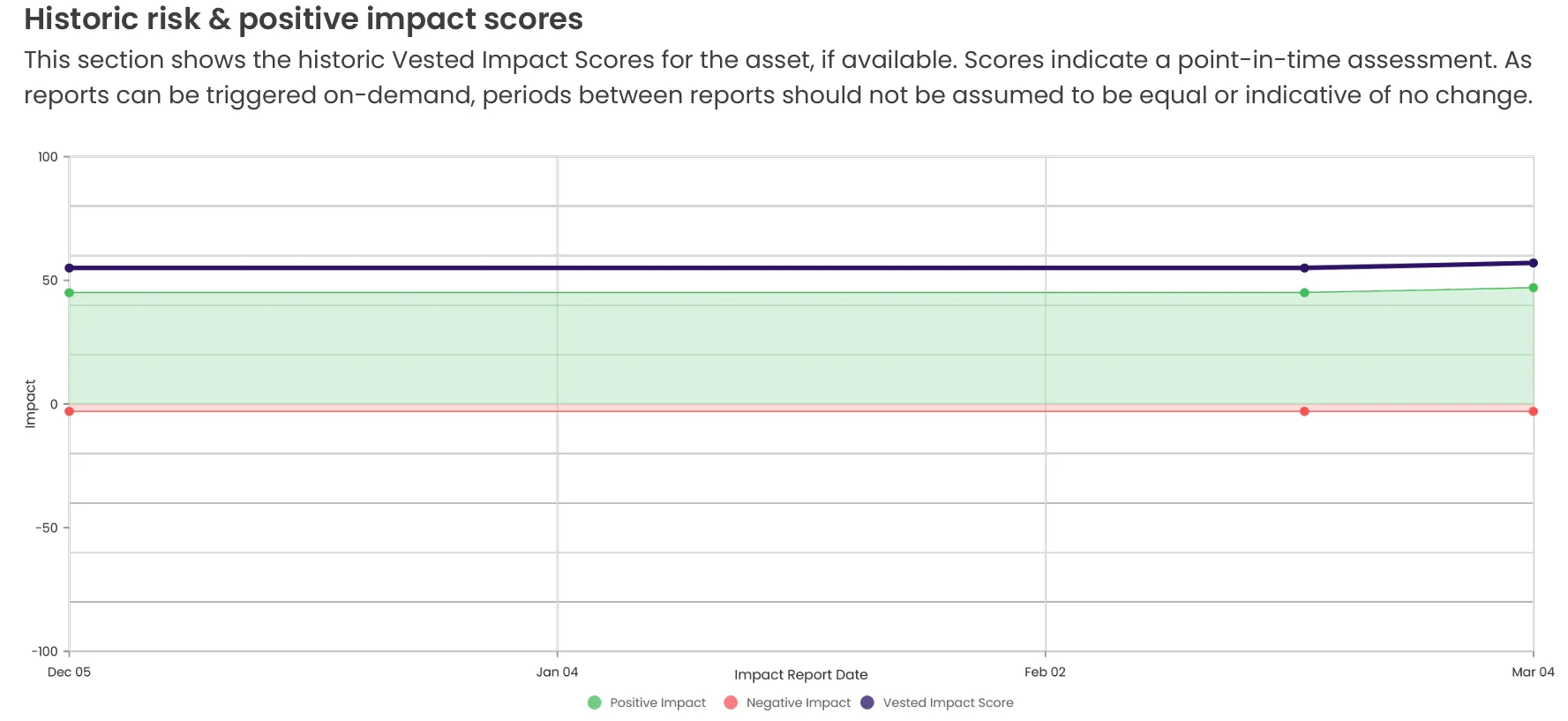
The Vested Impact report provides a snap shot in time of a company or group’s impact. Each time a user runs a report, the changes are tracked over time. For example, if a company establishes a new product or service or if they begin operating in a new country, that will have a material effect on their overall impact. Users can use this feature to monitor their company’s impact or even run hypothetical reports against their existing activities.
Note: Vested Impact does not automatically account for changes in a company’s business operations and activities.
UN SDGs & Targets
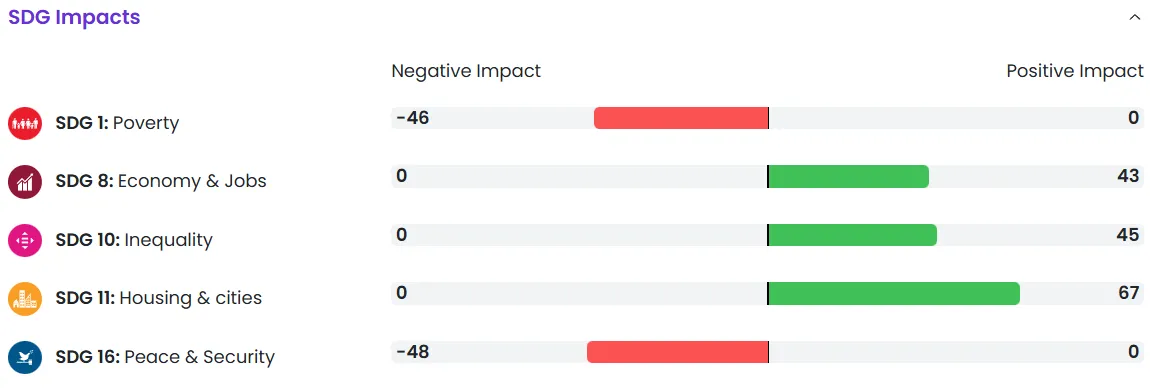
Vested Impact assesses the extent to which an asset’s activities are exposed to or contribute to environmental and social issues. Material impact is determined by mapping activities to the United Nations Sustainable Development Goals (UN SDGs) and their 169 underlying targets. These goals and targets provide the framework used to identify and categorise the environmental and social issues that are most relevant to a company’s activities.
The UN SDGs provide a globally recognised and widely adopted framework to define sustainable development priorities. Anchoring the methodology in this framework helps ensure that material impacts are assessed consistently and transparently, while remaining adaptable across sectors and geographies.
Activity Impacts
Activity Impacts
Vested Impact assesses risk and impact at an activity level. An activity is defined as any product or service an asset/company produces, delivers, or any action taken to develop, operate, or undertake those products and services.
Vested Impact calculates the material risks and impacts of each of an asset’s activities against each material issue it influences, in each of the countries it operates or delivers products or services in. Vested Impact leverages more than 200 million academic publications to identify and validate causal links between specific economic activities and environmental or social outcomes. Each activity is then assessed on how much it is exposed to, or has an impact on, over 150 material environmental and social issues.
Each activity/country/material issue combination (‘Impact Slice’) is evaluated and scored based on four core analytical pillars designed to assess a distinct dimension of risk and impact.
The core pillars are:
- Depth & Directionality: How directly, and to what degree, is the business activity is exposed to or contributing to the material issues?
- Market Context: How exposed to at-risk or high-need people or environments is the activity via the consumers, markets and environments they serve?
- Importance: How globally and locally important are the material risks and impacts of each activity in the markets/geographies impacted?
- Scale & Contribution: How much is the business activity exposed to the risk and/or contributing to the impact?
Each pillar score ranges from -100 to 100, with negative scores indicating material issue risk exposure and positive scores indicating positive impacts and opportunities.
We assume that an activity has greater risk or impact exposure when:
- It has a direct and material effect on the issue,
- It affects people or environments that are at-risk or high-need,
- The issue is considered socially or legally significant in the relevant markets, and
- The activity makes a substantial contribution to the issue (positively or negatively).
Country & SDG Target Impacts
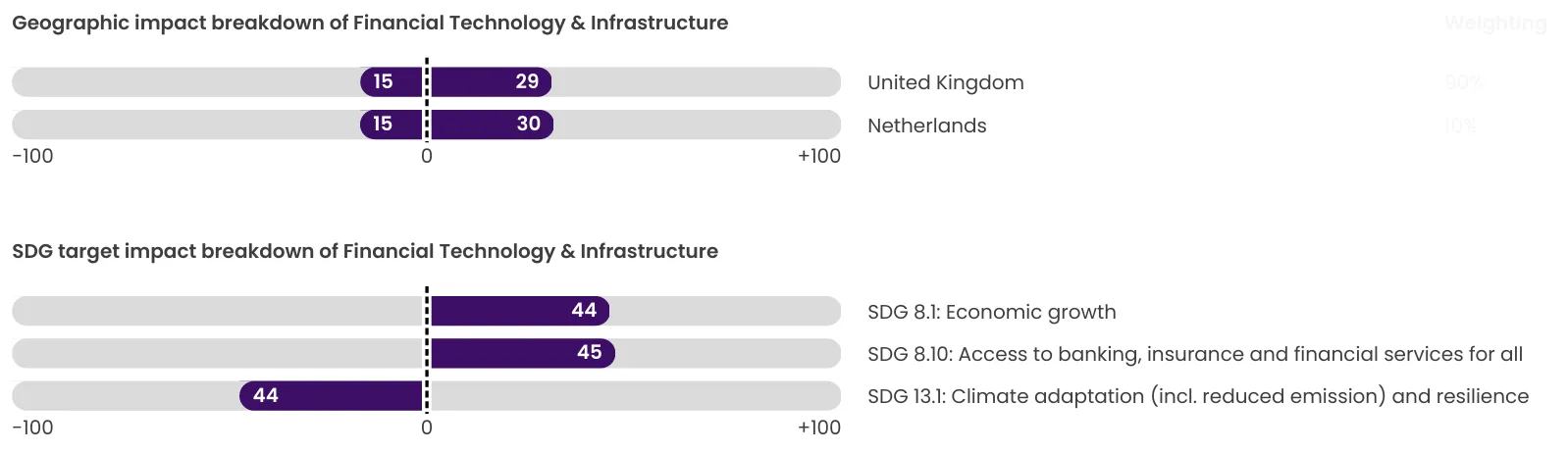
In addition to providing a score at the aggregated activity level for the asset/company, Vested Impact’s assessments also provide the underlying country and SDG Target impacts of each activity.
Based on the assessment across the four analytical pillars, Vested Impact provides:
- Country impact scores: indicate the level of material risk exposure, as well as potential positive impacts and opportunities, associated with each activity in the countries where it operates. These scores help highlight how impact and risk exposure may vary across geographic contexts.
- SDG Target Scores: indicate the level of material risk exposure, as well as potential positive impacts and opportunities, associated with each activity across the environmental and social issues it influences or is exposed to, aligned with the relevant UN SDG Targets. These scores help identify which SDG targets are most materially affected by a company’s activities.
Activity & Country Weightings
Activity Weightings
Activities can be weighted based on the share of overall revenue generated from different products and services across the business. For example, an automobile manufacturer that attributes 20% of its revenue to petrol vehicles and 80% to electric vehicles can reflect this proportional difference when weighting its business activities.
Country Weightings
Similarly, users can adjust the weightings for the company’s countries of operation. This allows market and regional nuances to be assessed per activity. For example, regulatory requirements in different regions, such as human rights law, that contribute to risk exposure can be accurately captured in the assessment.
When weights are unknown, equal weightings are automatically applied. Vested Impact does not estimate weightings in lieu of detailed activity or market segmentation data, unless provided by the user.
Systemic Risk & Opportunity Flags
In addition to quantified scores, Vested Impact uses Flags to identify critical risks and considerations that cannot be meaningfully reduced to numerical measures, or that represent broader systemic exposures linked to a company’s activities, markets, and/or geographies.
Flags highlight exposure to regulatory, legal, reputational, or standards-based risks, as well as alignment with leading thematic frameworks. They ensure that inherently significant or pervasive issues — such as human rights, biodiversity protection, or framework-based obligations — are clearly surfaced for further attention.
Flags are not a substitute for detailed due diligence - they provide a rapid and structured mechanism to highlight areas requiring deeper investigation, escalation, or engagement.
While Risk-aligned Flags surface potential harms and exposures tied to regulatory, legal, or reputational concerns, Framework-Aligned Flags highlight where activities demonstrate alignment with recognised global frameworks and can signal both risks and opportunities. Together, they ensure that users are alerted to critical issues requiring caution as well as areas where activities connect positively with established standards.
ESG Risks & Opportunities
ESG Impact & Financial Materiality
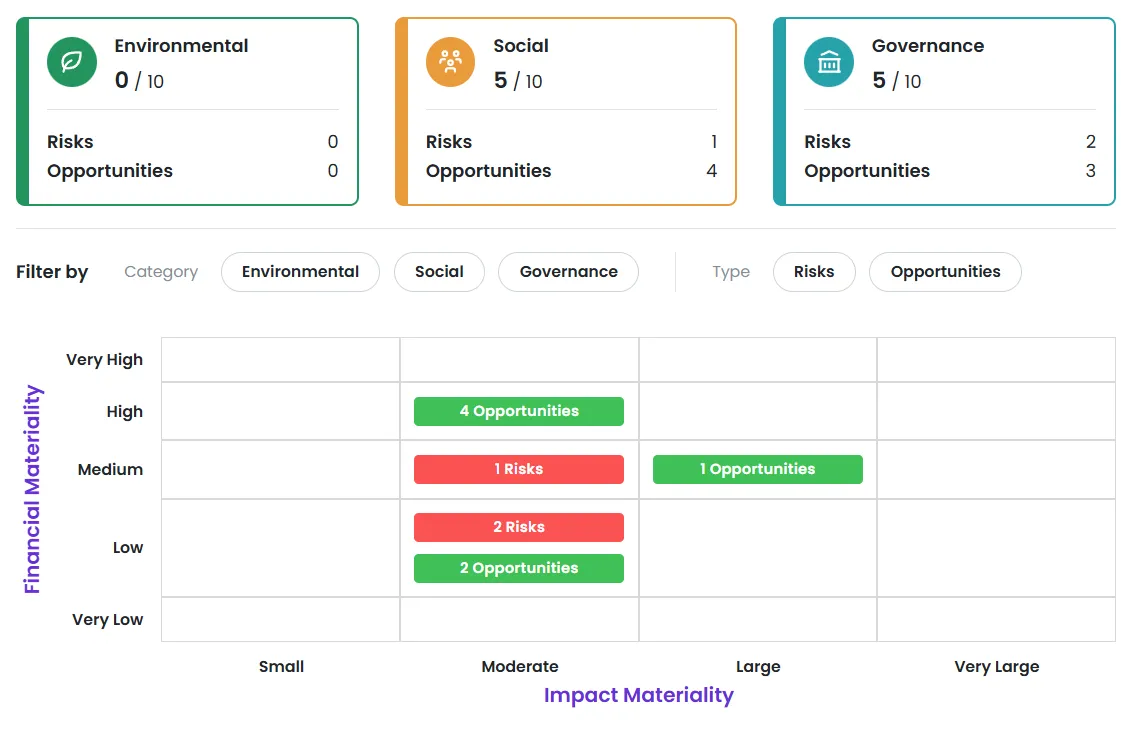
Vested Impact assesses ESG risks and opportunities based on an asset’s exposure to Impact Materiality and Financial Materiality.
Impact Materiality examines the external effect a company’s activities have on the environment and society. This covers the impact across a company’s supply chain, including direct business operations and activities, as well as upstream and downstream impacts.
Examples of Impact Materiality:
- Social Risk: Manufacturing in regions with weak labour protections may increase exposure to human rights violations.
- Environmental Opportunity: Activities that support renewable energy development can contribute positively to climate mitigation and environmental outcomes.
Financial Materiality assesses how an asset’s activities impact financial metrics, including access to capital, revenue, and investment opportunities. Vested Impact bases financial materiality on the financial scale of an asset, including size/total revenue and growth rate data.
Examples of Financial Materiality:
- Governance Risk: High-emitting companies may face increased costs from carbon pricing, regulation, or transition policies.
- Social Opportunity: Companies associated with advancing sustainable development may benefit from improved reputation, positive returns on investment, and access to capital.
ESG Risks & Opportunities
Vested Impact assesses a company’s ESG impact in terms of activity-level exposure to risks and opportunities. Each activity, product, and service, conducted by a business is individually scored on a -100 to 100 scale.
- Negative scores indicate a potential risk or adverse impact
- Positive scores indicate a potential opportunity or beneficial impact
This level of analytical depth enables users and capital allocators to integrate these metrics into their due diligence screening, reporting, and portfolio management processes. Vested
Impact equips customers with the robust, decision-useful data needed to identify and manage risks, and capitalise on high-impact opportunities.
References & Benchmarks
Goal-based Benchmarks
For each activity, Vested Impact provides relevant goal-based benchmarking, which compares the overall spend growth rate of the business with the required growth rate for relevant sustainability indicators associated with that activity to meet key sustainability goals and targets. Each benchmark indicator shown is aligned to the SDG Targets materially impacted (positively or negatively) by the asset or company.
This comparison helps users assess whether the company’s overall growth trajectory is aligned with sustainability pathways linked to the activities it performs. Where a company’s growth rate exceeds the required benchmark, this may indicate that the scale of the business is expanding at a pace consistent with achieving the relevant SDG targets. Where growth falls below the benchmark, it may highlight potential transition gaps, risks, or areas where increased investment, operational change, or strategic focus may be required.
These insights can be used to assess alignment with sustainability goals, identify priority areas for engagement, and inform investment, portfolio management, or transition planning decisions.
Indicators & Academic References
Vested Impact provides a full breakdown of the country-specific indicators used as part of the risk and impact assessment, enabling transparency, auditability, and justification of the results. A list of the academic papers used to determine the causal links between activities and material environmental and social issues is also provided to support methodological transparency and allow users to review the underlying scientific evidence.
Together, these resources provide full auditability, enabling users to better understand how results were derived, support internal validation processes, and provide justification for reporting, engagement, or investment decision-making.
Business Metrics
Using the revenue data captured at the report generation stage, Vested Impact calculates estimated environmental metrics such as emissions, water usage, and land use by leveraging Environmentally Extended Input-Output (EEIO) models, specifically the USEEIO models.
These metrics are available at the company-level and at an activity-level, taking into account the activity weightings applied during the report setup.
The USEEIO framework maps economic activities to environmental footprints, allowing upstream and downstream impacts to be traced across supply chains. By linking company financial or activity data to the relevant economic sectors within USEEIO, Vested Impact proportionally calculates estimates and allocates sector-wide environmental impact factors to individual businesses, products, and services.
By combining USEEIO multipliers with AI-powered classification and data ingestion, Vested Impact delivers granular, objective, and decision-useful sustainability insights at global scale, supporting businesses and investors in making informed, impact-driven decisions and enabling:
- Addressing data gaps
- Benchmarking at an asset/company or portfolio-level
- Comparing potential impacts across companies, activities, industries
Topics:
ESG
Impact Data
Impact Measurement
Platform Features
SDGs
User Guides
Get the risk intelligence you need
Complete the form and tell us a bit about your needs.
One of our team will be in
contact to see how we can help.